Inside the Document Parsing Engine
Modern organizations generate and process enormous volumes of documents every day. Contracts, invoices, reports, applications, statements, and compliance records contain valuabl...
Inside the Document Parsing Engine
Introduction
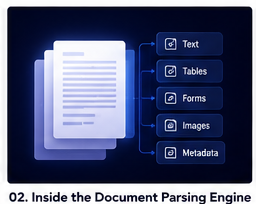
Modern organizations generate and process enormous volumes of documents every day. Contracts, invoices, reports, applications, statements, and compliance records contain valuable information that must be extracted, validated, and made accessible. As AI adoption accelerates, document intelligence has become a critical capability for enterprises seeking operational efficiency and better decision-making.
This article explores the concepts, architecture, challenges, and best practices behind Inside the Document Parsing Engine.
Why This Problem Matters
Many business processes still depend on manual review of documents. Teams spend significant time locating information, validating fields, correcting inconsistencies, and moving data between systems. These repetitive activities slow operations and increase the risk of human error.
Modern document intelligence systems aim to automate these processes while preserving accuracy and traceability.
Core Architecture
A robust architecture typically includes:
- Document ingestion
- OCR and parsing
- Classification
- Extraction
- Validation
- Storage and retrieval
- Monitoring and governance
Each stage contributes to the overall quality of the final output.
Common Challenges
Organizations often encounter:
### Inconsistent Document Formats
Documents arrive in different layouts and structures. Systems must handle scanned images, digital PDFs, forms, tables, and mixed-content documents.
### Accuracy Requirements
Business workflows require reliable results. Errors in extracted information can affect compliance, reporting, and customer experience.
### Scalability
As volumes grow, systems must process thousands or millions of documents efficiently.
### Explainability
Users need visibility into how results were produced and where extracted values originated.
Best Practices
### Build Reusable Components
Separate parsing, extraction, and validation into reusable services.
### Use Structured Outputs
Schemas and validation rules improve consistency and reduce downstream issues.
### Monitor Quality
Track accuracy, confidence scores, throughput, and failure rates.
### Keep Humans in the Loop
Critical workflows benefit from review and approval processes when confidence is low.
Business Impact
Organizations that implement document intelligence successfully often achieve:
- Reduced manual effort
- Faster processing times
- Improved data quality
- Better compliance outcomes
- Enhanced customer experiences
These benefits compound over time as document volumes increase.
Looking Ahead
The future of document intelligence will combine OCR, Vision Language Models, retrieval systems, automation workflows, and governance frameworks into unified platforms. Enterprises that invest early will be better positioned to unlock the value hidden within unstructured information.
Conclusion
Inside the Document Parsing Engine represents an important capability within modern AI-powered document workflows. By focusing on reliability, scalability, and explainability, organizations can transform documents from operational bottlenecks into strategic assets.