RAG Pipelines for Enterprise Document Intelligence
Document intelligence is evolving from simple OCR and data extraction into a complete operational layer for modern enterprises. Organizations increasingly rely on AI-driven work...
RAG Pipelines for Enterprise Document Intelligence
Introduction
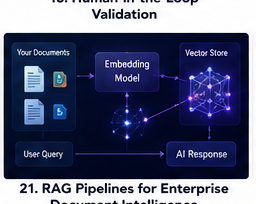
Document intelligence is evolving from simple OCR and data extraction into a complete operational layer for modern enterprises. Organizations increasingly rely on AI-driven workflows to process, understand, validate, and act on information contained within documents.
This article explores RAG Pipelines for Enterprise Document Intelligence, including the technical challenges, implementation strategies, and business outcomes associated with modern document processing systems.
The Business Challenge
Large organizations manage contracts, invoices, reports, applications, compliance records, customer documents, and operational paperwork at significant scale. Manual processing slows operations, introduces inconsistencies, and increases operational costs.
To address these challenges, enterprises are investing in platforms that combine machine learning, workflow automation, retrieval systems, validation layers, and governance controls.
Technical Foundations
A successful implementation typically includes:
- Document ingestion and storage
- Parsing and OCR
- Classification and routing
- Structured extraction
- Validation and review workflows
- Monitoring and analytics
- Governance and compliance controls
These components work together to transform raw documents into usable business data.
Architecture Considerations
### Scalability
Systems must support increasing document volumes without sacrificing performance.
### Reliability
Outputs should remain consistent across different document formats and workflows.
### Explainability
Users need visibility into how information was extracted and validated.
### Integration
Document systems rarely operate in isolation. They must connect to existing business applications, databases, analytics platforms, and operational processes.
Best Practices
### Start with Clear Objectives
Identify business outcomes before implementing technical solutions.
### Establish Validation Layers
Use confidence scores, business rules, and review workflows to maintain quality.
### Design for Reuse
Build reusable parsing, extraction, and retrieval services rather than isolated workflows.
### Measure Performance
Track throughput, latency, extraction quality, review rates, and operational efficiency.
Real-World Benefits
Organizations commonly achieve:
- Faster document processing
- Reduced manual effort
- Better data consistency
- Improved auditability
- Increased compliance readiness
- More efficient knowledge discovery
Future Outlook
Advances in Vision Language Models, retrieval systems, agentic workflows, and automation platforms will continue to expand what organizations can accomplish with document intelligence.
The most successful implementations will focus not only on automation but also on trust, governance, transparency, and long-term maintainability.
Conclusion
RAG Pipelines for Enterprise Document Intelligence is becoming increasingly important as enterprises seek to unlock value from unstructured information. By combining AI capabilities with strong engineering foundations, organizations can build scalable and reliable document intelligence systems that support both operational efficiency and strategic decision-making.